
I recently enjoyed a few days away in Norfolk, on my East Anglian Cities Tour. Whilst in Ely I visited the home of Oliver Cromwell, now a living museum to his life there.
His study gave me the opportunity to revisit how we wrote in the 17th century. A far cry from the modern world of word processing and e-comms!
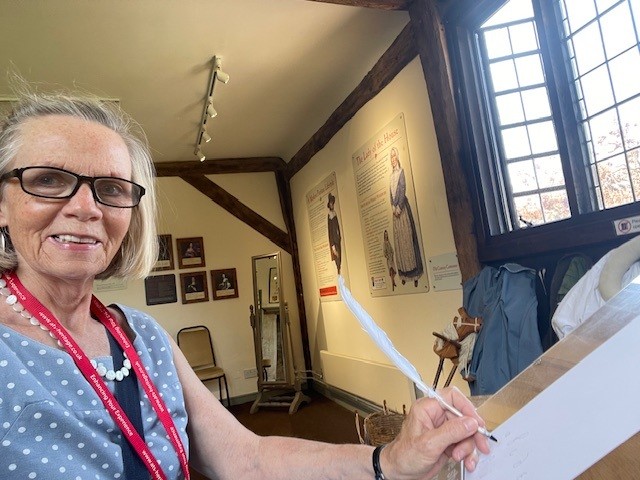
As I struggled with the quill, and laboured to form any intelligible letters, I realized just how hard handwriting is for many many children these days. Beyond the obvious matters of grip, pressure, and – as a left hander trailing your hand across fresh ink! – the more fundamental issue of WHAT am I writing, for WHOM am I writing, and WHY am I writing.
It struck me that these are questions our PDA youngsters must ask themselves every day. And they face added pressures from the actual expectation that they will engage with the whole process of committing thoughts to text.
In creating the manuscript that will one day become ‘New Insights into PDA’, I can now reveal some of the challenges I face daily in the craft and graft of writing.
For a start …
- There’s the cognitive and mental challenges: thinking, constructing sentences, remembering grammar and punctuation
- Then there’s the negative mindset and perfectionist traits: The voice says something like ‘I can’t do this!’ and ‘Will it ever be good enough?’
- Then there’s the whole notion of energy and flow (and dealing with writer’s block)
Some of you may know the panel game on BBC Radio 4 called ‘Just A Minute’. Here guests are required to speak for one minute, unprepared, on a topic they are given. But here’s the catch: it has to be without hesitation, duplication, or repetition. This poses some challenges even for hyper fluent speakers! And writing for me – and all our PDA youngsters I suspect-, feels just like this, with all the pressures and the expectations, and the doubts.
Is it any wonder that PDA youngsters will avoid engaging in writing?
So when it comes to supporting youngsters with PDA with their writing or other forms of self-expression and creativity, I’d like to offer the following rubric:
- Ditch the pencil, or the quill! The insistence on learning correct letter formation is rapidly becoming outmoded and can be utterly traumatising for PDA children. Forget it. We don’t expect children with marked Cerebral Palsy to learn to write. In the 1980s – 40 years ago- my class of non-verbal CP primary age children – with good cognitive functioning- had very primitive switch devices connected to their computers powered with voice synth chips to support their writing, recording and communication.
- Offer the use of a scribe (Barbara Cartland used to dictate her novels to her Secretary). It must be someone whom the PDA youngster trusts to simply write down what they say.
- Be clear about the NEED (really?) or the PURPOSE of the writing – only do it if absolutely necessary.
- Consider other more creative ways of representation – drawing, singing, art work, physical work.
- Use IT: make IT available from an early age. There are some fantastic AAC* devices which PDA children love working with/through
- Encourage use of portable devices such as tablets, laptops, chrome books and support the use of voice dictation facilities on phones, and other devices.
- Never, never, never, expect them to copy write This is where schools make dreadful mistakes. It’s a no no.
- Consider the perception of the enormity of the task for the PDA youngster, together with the pressure of expectation, compounded by the ‘I can’t do this’ mindset.
And then one day, you might just see the results of their spontaneous, unprompted attempts at writing you notes or instructions.
Right. I’m off to change the ink cartridge. Not in my printer this time, but in my Waterman fountain pen. A 60th birthday present to myself when I felt ready, willing, and able, to use it.
Hilary
*Alternative & Augmentative Communication