
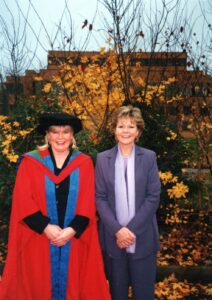
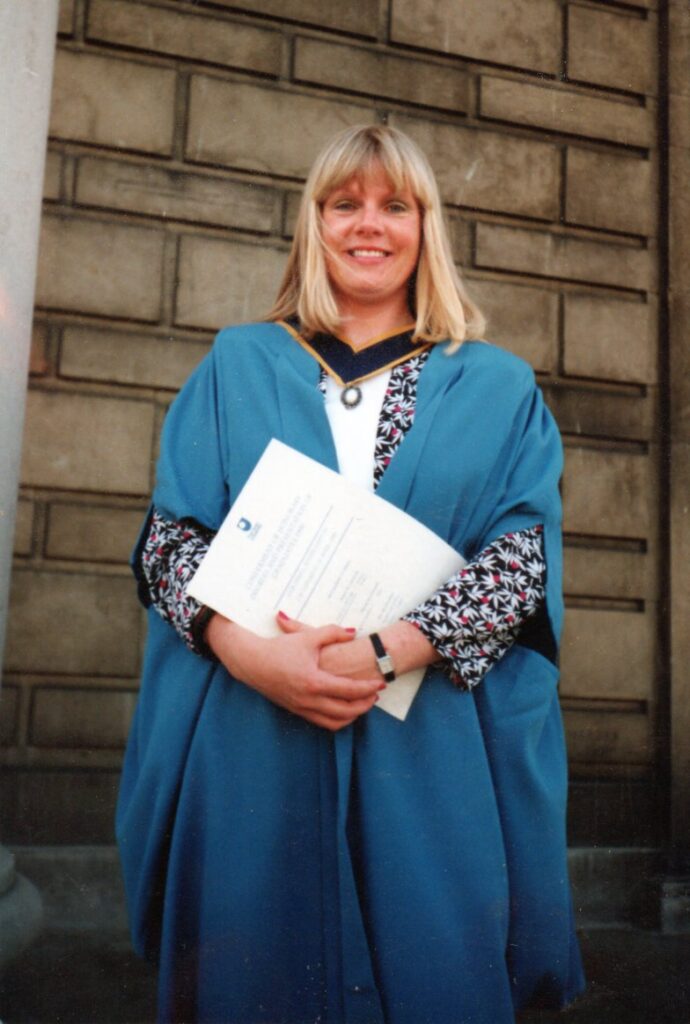
‘Can it really be that long ago?’ I asked myself, when I was looking at these photos. They are images of which I am still enormously proud, as they reflect my achievements in gaining my MA in Education degree from the Open University, in 1990, (blue gown) and my Doctorate in Educational Psychology in 2001 (red gown).
Studying at Masters and Doctoral level has provided me with an in-depth knowledge of both qualitative and quantitative research methods. And, more importantly, with a framework for assessing the quality of other people’s research. When you read an academic research paper you bring a critical mindset to it. You want to be able to assess the validity and reliability of the study, who the sample of participants was, whether there were any flaws or gaps which the author doesn’t address. Most of all you want to be able to assess what the paper contributes to the field of knowledge. Research is all about asking the right questions, and finding a way to answer -or at least address-those questions so that our knowledge moves on.
Now, I have been reading, and re-reading, vast tranches of the published literature on PDA, and applying this critical evaluative mindset to the research. I talked in my last post about how I had done this with Elizabeth Newson’s original PDA papers, and how I had spotted some gaps and areas she had overlooked – most likely because she hadn’t appreciated the significance of these at the time. It just shows how much our knowledge has moved on in the last couple of decades.
I’ve also been re-reading Phil Christie’s articles, books, and conference presentations too, and those of other post-Newsonians (e.g. Ruth Fidler, Jill Davis, ENC staff) because I wanted to examine how their understanding of PDA has developed since the early days. From this, I have been able to see the ‘direction of travel’ which their writing about PDA has taken and how our knowledge about PDA has augmented, and our thinking changed.
Then I re-visited Liz O’Nions work on developing the EDA-Q, and her other conceptual and theoretical work around what PDA is, and where it might be located.
We must also remember the vivid, rich descriptive accounts of parents, such as Jane Sherwin’s account of life with Mollie. And more recently the blogs such as Steph’s Two Girls.
Next, we have the accounts of life as an adult with PDA, and the two extraordinary insights and memoirs of Harry Thompson and Julia Daunt.
All of these give us amazing and valuable accounts of PDA from different perspectives.
And you know what? They are all valid and important in the generation and sharing of knowledge about PDA, all part of the PDA Family of Research. None in my view are ‘better’ or ‘worse’. They all tell us something – from different perspectives of course- about the perplexing nature and condition which is PDA.
So where will my book ‘New Insights into Pathological Demand Avoidance’ fit into this family? I envisage that it will have an important place in that family as a book which reflects my clinical practice in PDA, and which draws on my observations of scores of children I have been privileged to meet and attempt to engage with. It also brings a fair few insights which are drawn from my Doctoral studies in Educational Psychology at Bristol in the 1990s. So really I feel well placed to be writing the book and sharing my new insights about PDA, even if it is taking me a long, long, while to do so.
Thank you to all of you who are waiting patiently for the book’s completion. I will keep you all updated.
Warmest wishes from a chilly, rainy, North Yorkshire.
Hilary
30th September 2022